|
||
34. Schreibersite Crystals in an Ataxite |
| Listing of Structures |
| Back...Next |
| Meteorite - Gebil Kamil, ungrouped iron, ataxitic structure. |
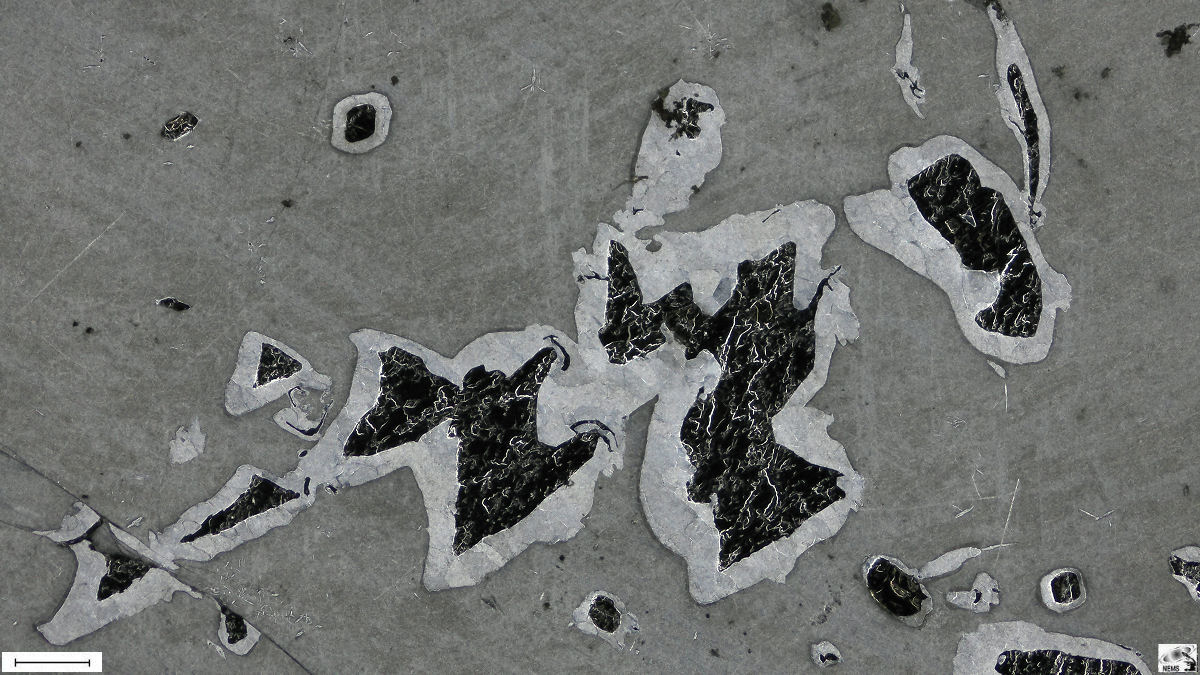
| Figure 1. Scale bar 1 cm. |
| Meteorite, Gebel Kamil, Ungrouped, ataxitic structure. |
| Crystals of schreibersite, troilite, and daubreelite enveloped in swathing kamacite. Reflected light image. The black color is a lighting artifact. Note the shear deformation in the lower left corner. |
| The Gebel Kamil meteorite, which formed a ~45 m impact crater in the Eastern Uweinat Desert of Egypt approximately 5,000 years ago (or less), is an ungrouped, nickel-rich ataxite characterized by ~20 wt% Ni. Its structure is dominated by a fine-grained plessitic matrix interrupted on a centimeter scale by prominent crystals of schreibersite, troilite, and daubréelite, each systematically enveloped in swathing kamacite. Figure 1. Reflected-light image of Gebel Kamil showing large schreibersite crystals (with associated troilite and daubréelite) enveloped in swathing kamacite. Note shear deformation in the lower left. The black areas are lighting artifacts. Scale bar: 1 cm. Figure 2. Additional view of schreibersite-troilite-daubréelite assemblages with swathing kamacite. Scale bar: 1 cm. Mineralogical and Textural Context In most iron meteorites, schreibersite ((FeNi)3P) occurs as small (millimeter-scale or smaller) crystals or rhabdites. In Gebel Kamil, however, schreibersite forms unusually large crystals that stand out against the ataxitic (non-Widmanstätten) matrix. These large phosphide crystals are surrounded by polycrystalline swathing kamacite (a rim of equant kamacite grains), with finer kamacite spindles (~20 µm wide) nucleating on smaller schreibersite particles and forming localized micro-Widmanstätten-like clusters rimmed by taenite. Accessory phases include troilite (FeS) and daubréelite (FeCr2S4) Formation Sequence and Petrogenesis The crystallization sequence in Ni-rich ataxites like Gebel Kamil reflects subsolidus reactions during slow cooling of the metallic melt. Taenite (high-Ni, face-centered cubic γ-FeNi) is the high-temperature phase that dominates initially. Upon cooling below ~700–800 °C (depending on bulk Ni and P content), kamacite (low-Ni, body-centered cubic α-FeNi) begins to precipitate. Schreibersite typically nucleates at lower temperatures (~600 °C or below) within kamacite or at interfaces, as phosphorus becomes less soluble in the metal phases. The large schreibersite crystals in Gebel Kamil are enveloped by swathing kamacite, which forms through localized nucleation and growth at the phosphide-metal interface. Phosphorus influences the surrounding metal by depressing the local solidus/phase boundary temperatures, facilitating the development of the kamacite rim even as the bulk meteorite cools. This produces the characteristic “swathing” texture observed here. Shear deformation features visible in some sections record later shock events, likely associated with the impact that produced the Kamil crater. Significance Gebel Kamil’s texture exemplifies how minor elements (especially P) control microstructure in high-Ni ataxites. Its ungrouped status, combined with high Ge and Ga contents, distinguishes it from other Ni-rich irons and highlights the diversity of parent-body processes in the early Solar System. The meteorite also provides a rare opportunity to study relatively recent impact cratering on Earth by an iron projectile. |
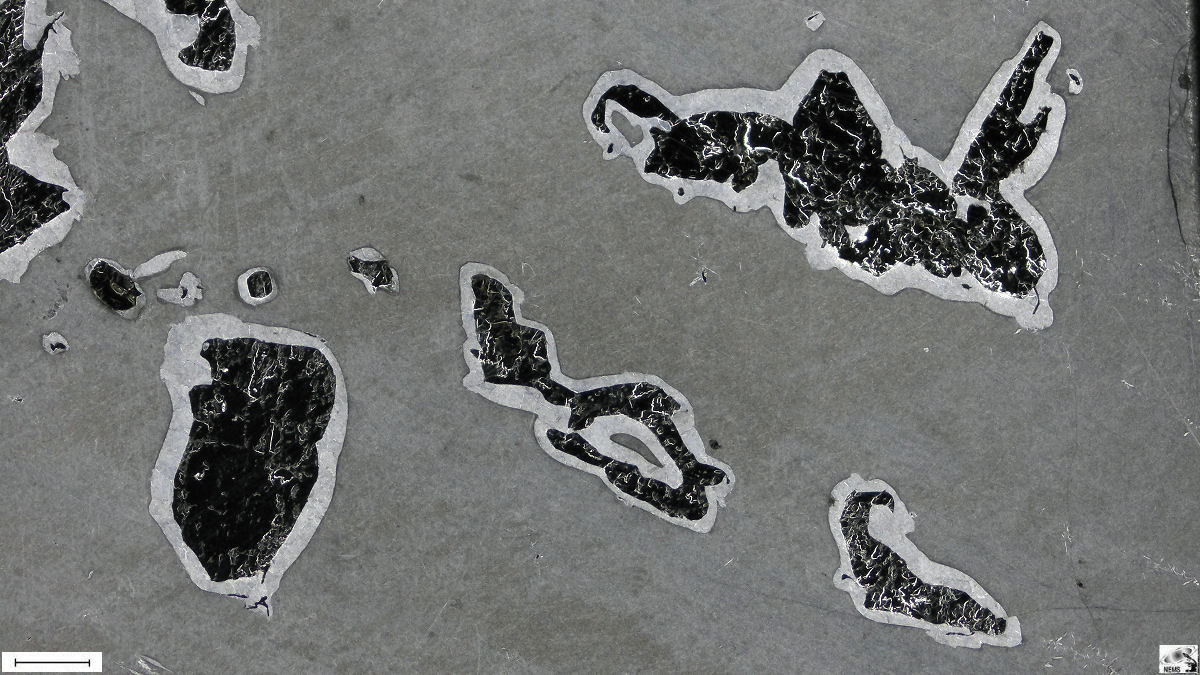
| Figure 2. Scale bar 1 cm. |
| Meteorite, Gebel Kamil, ungrouped, ataxitic structure. |
| Crystals of schreibersite, troilite and daubreelite enveloped in swathing kamacite. Reflected light image. The black color is a lighting artifact. |
| References • D’Orazio, M., Folco, L., et al. (2011). Gebel Kamil: The iron meteorite that formed the Kamil crater (Egypt). Meteoritics & Planetary Science. • Meteoritical Bulletin Database. • General references on schreibersite petrography (e.g., Buchwald, 1975, Handbook of Iron Meteorites; Clarke & Goldstein studies on phosphide growth). |
| Listing of Structures |